Micro-Duct vs Conventional Fiber Optic Systems in Qatar
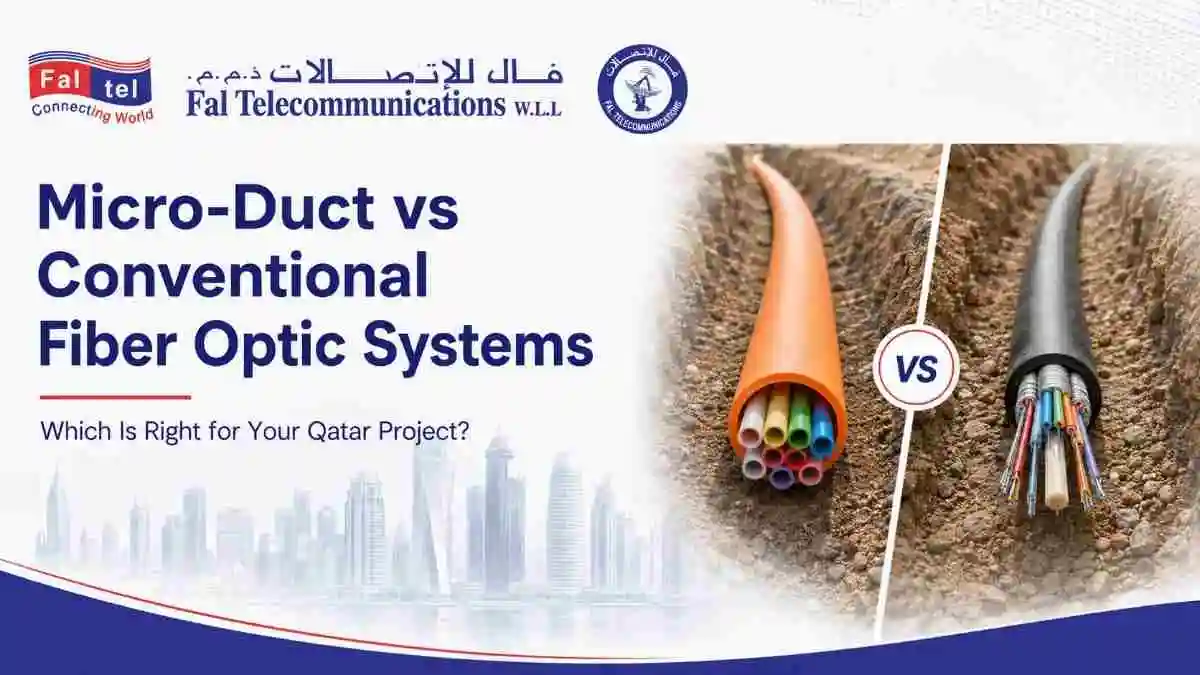
Which Is Right for Your Project?
Choosing between micro-duct and conventional fiber optic systems in Qatar can have a major impact on the long-term performance, scalability and cost of a telecom infrastructure project.
At first, the decision may seem like a simple engineering choice. But in practice, the system you select can determine how easily your network can expand, how much future excavation may be required and how manageable maintenance will be several years after installation.
For projects across Qatar, both systems have their place. The right choice depends on the site, expected future demand, available budget and how difficult it would be to modify the infrastructure later.
What Is the Difference Between Micro-Duct and Conventional Fiber?
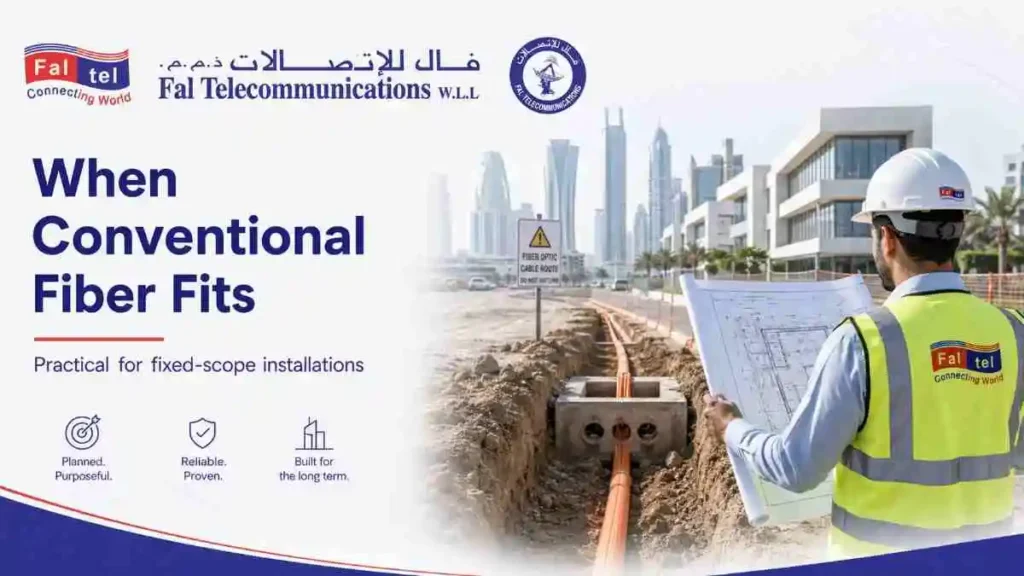
Conventional fiber installation is the traditional approach most people associate with fiber infrastructure.
The process normally involves:
- Preparing the route or trench
- Installing the required fiber optic cable
- Completing the installation based on the current project capacity
Once the cable is installed, the available capacity largely depends on what was originally designed and installed.
This method has been widely used across Qatar for many years because it is familiar, proven and straightforward for contractors to implement
Micro-Duct Fiber Systems
A micro-duct fiber system takes a more flexible approach.
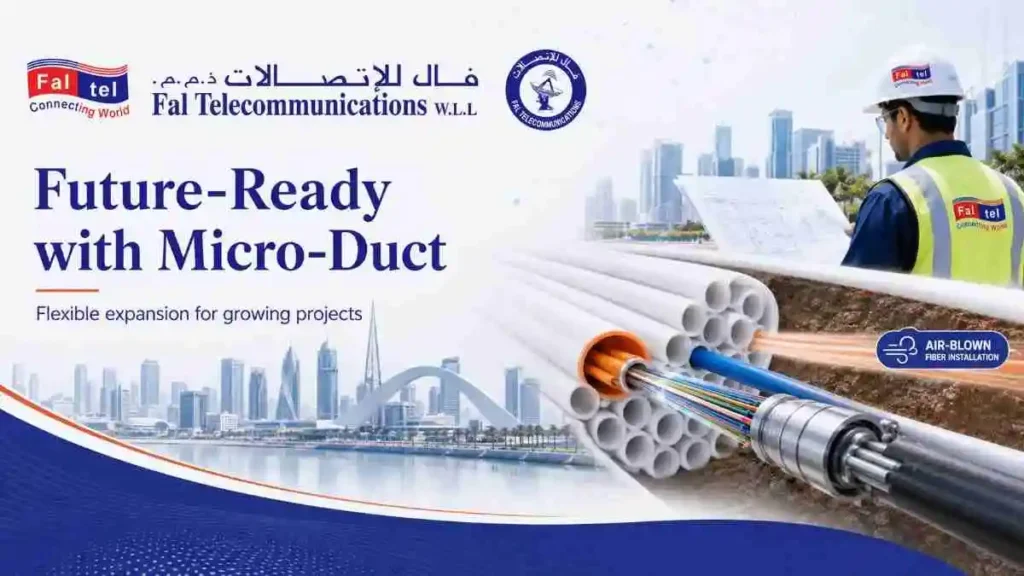
Instead of immediately installing one large cable, a network of small lightweight ducts is installed first. Fiber cables can then be introduced into these ducts later, typically using compressed-air cable-blowing methods.
This allows additional fiber to be installed when demand increases without necessarily reopening the entire route or carrying out major excavation again.
When Conventional Fiber Optic Installation Makes Sense in Qatar
Conventional fiber is not an outdated solution.
For projects with a clearly defined and stable requirement, it can still be the most practical option.
Examples may include:
- A single building
- A fixed number of users
- Small retrofit projects
- Sites where future expansion is unlikely
- Projects with a tightly controlled initial budget
For these types of projects, conventional fiber optic installation in Qatar may offer a more predictable initial cost and a simpler installation process.
Contractors are also highly familiar with conventional fiber systems, which can make project planning and implementation straightforward.
The main limitation appears when additional capacity is required later.
Once the original cable is installed underground or inside completed infrastructure, adding new fiber may require new civil works or excavation. In busy areas of Doha or locations with existing infrastructure, carrying out additional digging can become complicated and disruptive.
Benefits of Micro-Duct Fiber in Qatar
For projects where growth is expected, micro-duct fiber in Qatar can provide greater flexibility.
This is particularly relevant for:
- New commercial developments
- Industrial zones
- Large infrastructure projects
- Smart-city developments
- Multi-building sites
- Projects where future bandwidth demand is uncertain
Easier Future Expansion
One of the biggest advantages of micro-duct systems is the ability to expand fiber capacity later.
Once the duct infrastructure is installed, additional fiber can be blown through available ducts when required.
This can reduce the need for future trenching and civil work.
Reduced Repeat Excavation
Repeat excavation can be expensive and disruptive.
It may involve:
- Road closures
- Additional permits
- Civil contractors
- Traffic management
- Reinstatement works
- Longer project timelines
For sites close to government facilities, busy roads or existing infrastructure, avoiding repeated excavation can be particularly valuable.
Micro-duct infrastructure provides a pathway for future fiber expansion without repeatedly disturbing the completed site.
Micro-Duct vs Conventional Fiber: Scalability
Scalability is becoming increasingly important in Qatar’s telecom infrastructure.
Bandwidth requirements can change quickly as:
- Data consumption increases
- New buildings are developed
- Smart technologies are introduced
- Businesses expand
- Digital services become more demanding
A conventional fiber network must generally be designed with enough capacity from the beginning.
Micro-duct infrastructure provides more flexibility because additional cables can potentially be installed later as requirements change.
For projects where future demand is difficult to predict, this flexibility can provide significant long-term value.
A good system helps schedule preventive maintenance before equipment fails. This reduces downtime, lowers repair costs, and extends asset lifespan.
Installation Considerations
Micro-duct systems can also provide practical installation advantages.
The ducts are relatively lightweight and can be easier to handle in locations where space is restricted.
This can be useful for:
- Urban developments
- Existing buildings
- Retrofit projects
- Congested infrastructure corridors
- Sites with limited working space
In some situations, installation teams may be able to work more efficiently with micro-duct infrastructure than with heavier conventional cable installations.
Micro-Duct vs Conventional Fiber Comparison
| Factor | Micro-Duct Fiber | Conventional Fiber |
|---|---|---|
| Initial Cost | Generally higher | Generally lower for fixed projects |
| Future Expansion | Easier to expand | May require additional civil works |
| Scalability | High | Depends on original installed capacity |
| Repeat Excavation | Often reduced | May be required |
| Installation Flexibility | Suitable for growth-oriented infrastructure | Suitable for clearly defined projects |
| Maintenance | Individual cables may be replaced more easily | Can be more complex in bundled installations |
| Best For | Large, growing or future-ready projects | Small, fixed-scope projects |
This comparison reflects the project considerations discussed in the original article.
Maintenance and Long-Term Network Management
Maintenance is another area where the two systems can differ.
With micro-duct, an individual cable can potentially be removed and replaced without disturbing other cables inside the infrastructure.
This can make maintenance and future upgrades more manageable.
With conventional installations, particularly older systems where several cables may be grouped together, maintenance can be more complicated. Work on one cable may also create additional risks for surrounding infrastructure
Which Fiber Optic System Is Right for Your Qatar Project?
There is no single answer for every project.
Conventional fiber may be suitable if:
- The project is small
- The number of users is fixed
- Future growth is unlikely
- The network requirement is already clearly defined
- Initial budget is the main consideration
Micro-duct may be more suitable if:
- The project may expand
- Future bandwidth requirements are uncertain
- Additional buildings may be added
- The site is in a busy or difficult-to-excavate location
- Long-term scalability is important
- Future civil works would be expensive or disruptive
For many large or growth-oriented projects in Qatar, flexibility can become increasingly valuable as connectivity requirements continue to evolve.
The right solution should not only track assets but also help improve daily operations and long-term planning.
Frequently Asked Questions (FAQ)
Micro-duct fiber uses a network of small ducts through which fiber optic cables can be installed, often using compressed-air cable blowing. This allows additional fiber to be introduced later when network capacity needs increase.
Not necessarily. Micro-duct can be better for projects requiring future scalability, while conventional fiber may be more suitable for smaller projects with stable, clearly defined requirements.
Micro-duct can require a higher initial investment because the duct infrastructure needs to be installed first. However, it may reduce future costs when additional fiber capacity is needed because new excavation may not be necessary.
The best solution depends on the project's size, site conditions, expected growth, existing infrastructure, budget and how difficult future excavation would be. A site assessment should be carried out before choosing between the two systems.
Need Help Choosing the Right Fiber Solution?
If you are planning a new fiber optic infrastructure project in Qatar, selecting the right system at the beginning can help avoid unnecessary cost and disruption later.
Contact FAL Telecommunications for a project assessment and discuss whether micro-duct or conventional fiber is the right solution for your site.
Latest Post


Get in Touch