What Do Low Voltage Systems Include in a New Building in Qatar?
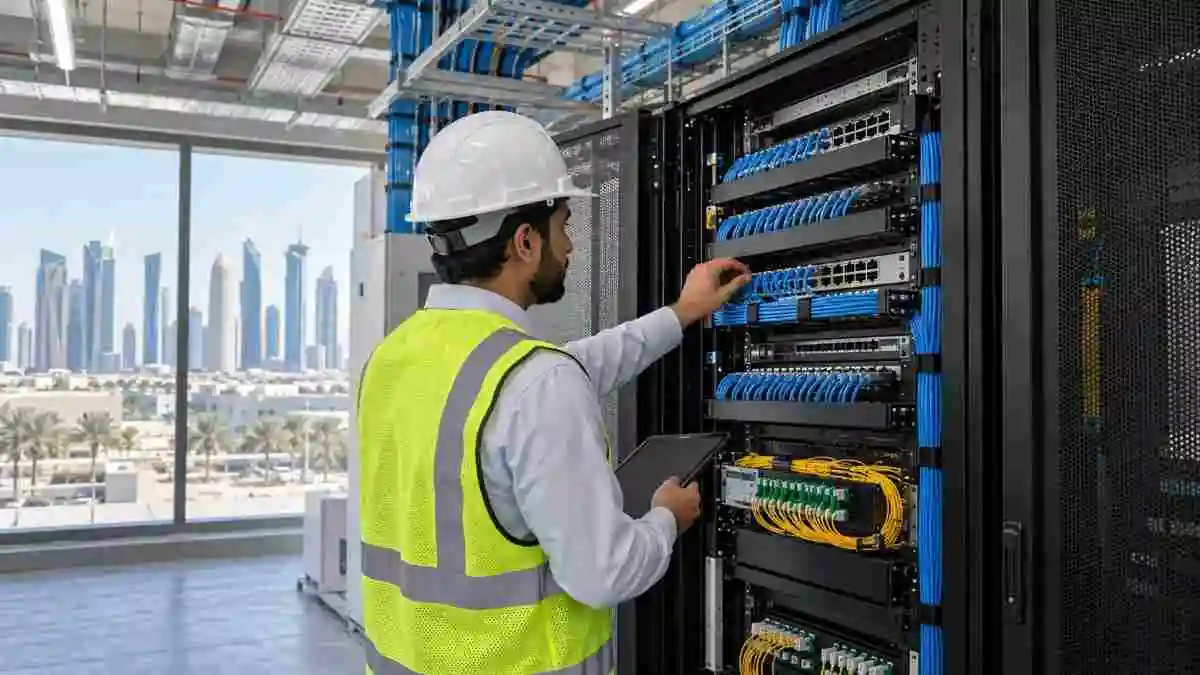
Quick answer: A new building’s ELV or light current package can include structured cabling, data networks, Wi-Fi, CCTV, access control, intercom, telephone systems, audio-visual equipment, and building controls. Fire detection and emergency communication systems require their own specified infrastructure and approvals. The exact scope depends on the building’s use, design, and applicable requirements.
Planning these systems early helps ensure that cable routes, equipment rooms, power supplies, and interfaces are coordinated before construction progresses.
What Are Low Voltage and ELV Systems?
In Qatar’s construction industry, “low voltage systems” is often used informally to describe communications, security, and control systems. These packages are also called ELV systems or light current systems.
However, electrical engineers also use “low voltage” for power distribution. Tender documents and drawings should therefore distinguish electrical power works from communications and specialist system packages.
These systems exchange information, support communication, monitor equipment, or control access. Some connections, such as Power over Ethernet, carry both data and electrical power.
What Systems Might a New Building Need?
The following systems are commonly considered during building design. Not every project needs every system.
|
System |
Main purpose |
Typical locations |
|
Provides copper and fibre connections for networked equipment |
Communications rooms, risers, work areas |
|
|
Data networks and Wi-Fi |
Connects users, applications, and devices |
Offices, classrooms, public areas |
|
PABX and IP telephony |
Supports business calls and internal communication |
Reception, offices, operational areas |
|
CCTV |
Provides surveillance and recording |
Entrances, circulation areas, car parks |
|
Access control and intercom |
Manages entry and visitor communication |
Doors, gates, reception |
|
Fire detection and alarm |
Detects specified fire conditions and raises alerts |
Locations defined by the approved design |
|
Public address and voice evacuation |
Provides routine announcements or emergency instructions through appropriately designed systems |
Lobbies, corridors, large spaces |
|
Audio-visual systems |
Supports presentations, conferencing, and displays |
Meeting rooms, classrooms, auditoriums |
|
Building management system |
Monitors and controls selected building equipment |
Plant rooms, control rooms |
|
SMATV or IPTV |
Distributes television services where specified |
Hotels, residential buildings, hospitality spaces |
|
In-building mobile coverage |
Improves indoor cellular coverage through an operator-coordinated solution |
Basements, towers, large buildings |
An office may prioritise connectivity, telephony, and meeting-room technology. A hotel may also require television distribution, guest networks, and room-related controls.
What Approvals Should You Consider in Qatar?
Approval requirements depend on the building, system, and project location.
Fire detection, alarm, and other life safety provisions must follow the applicable Qatar Civil Defence requirements and the approved fire strategy. Confirm the required systems, submissions, inspections, and responsible specialists with the project consultant. Qatar Civil Defence publishes technical requirements covering fire protection and building services.
Other packages may require separate authority, operator, or client approvals. Prepare an approval responsibility matrix early, identifying who designs, submits, installs, tests, and obtains acceptance for each system.
When Should You Plan ELV Systems?
Begin during the design stage, alongside architectural, structural, and MEP coordination.
Early planning should establish:
- Communications room locations, rack space, and maintenance access.
- Cable trays, conduits, risers, and routes between buildings.
- Power, backup power, cooling, and earthing requirements.
- Separation from other services and suitable fire stopping.
- Device locations coordinated with ceilings, doors, and furniture.
- Capacity for agreed future expansion.
Planning tip: Allow spare capacity based on expected growth. Additional rack space and accessible pathways can make later changes easier, but allowances should be defined rather than assumed.
How Do These Systems Work Together?
Some systems can use coordinated IP infrastructure, provided that security, network separation, bandwidth, and availability requirements are addressed. Explore Fal Telecom’s network and IT solutions in Qatar for support with network design and integration.
For example, CCTV cameras may connect to dedicated network segments, while access control software exchanges selected information with a management platform.
Integration does not mean putting every system on one unrestricted network. Fire and life safety systems need their specified infrastructure and approved interfaces. Emergency voice evacuation also has different requirements from ordinary background music or announcements.
Document the required interfaces and test them against an agreed sequence of operation.
What Happens When Coordination Is Delayed?
Consider a hypothetical office project where cabling, CCTV, and access control are designed separately. Device locations may conflict with ceiling features, cable routes may lack capacity, and door hardware may not match access control requirements.
A coordinated design, clear responsibilities, and an agreed installation sequence help reduce these problems. They also make testing and fault investigation more straightforward.
What Should You Look for in a Contractor?
hoose a contractor with relevant project experience and a clearly defined scope. Ask how it will coordinate specialist interfaces, obtain necessary approvals, and support the installation after handover.
Request:
- As-built drawings and cable schedules.
- Cabling test results and commissioning records.
- Equipment lists, warranties, and operating manuals.
- Secure transfer of administrator access.
- User training and a defined maintenance scope.
Fal Telecom’s published services include structured cabling, PABX, SMATV, and BMS solutions. Discuss the project requirements to confirm which packages and interfaces are included in the quotation.
Frequently Asked Questions (FAQ)
They are sometimes used interchangeably in construction discussions, but their technical meanings differ. Define the intended systems clearly in project documents.
Most need some communications infrastructure. Security, telephony, and other requirements depend on operations, occupancy, and the approved design.
No. Shared infrastructure requires careful design, and some systems need separate networks, dedicated infrastructure, or approved interfaces.
Responsibilities vary by contract. The consultant typically establishes requirements, while specialist contractors prepare detailed submissions within their assigned scope.
Often, yes. Feasibility and cost depend on available pathways, equipment capacity, access, and any approval requirements.
Planning a building or fit-out in Qatar? Contact Fal Telecom to discuss your communications and ELV requirements and request a quotation.
Get in touch for a quote or to discuss your project requirements.