Office Network Setup in Qatar: A Checklist Before Moving to a New Office
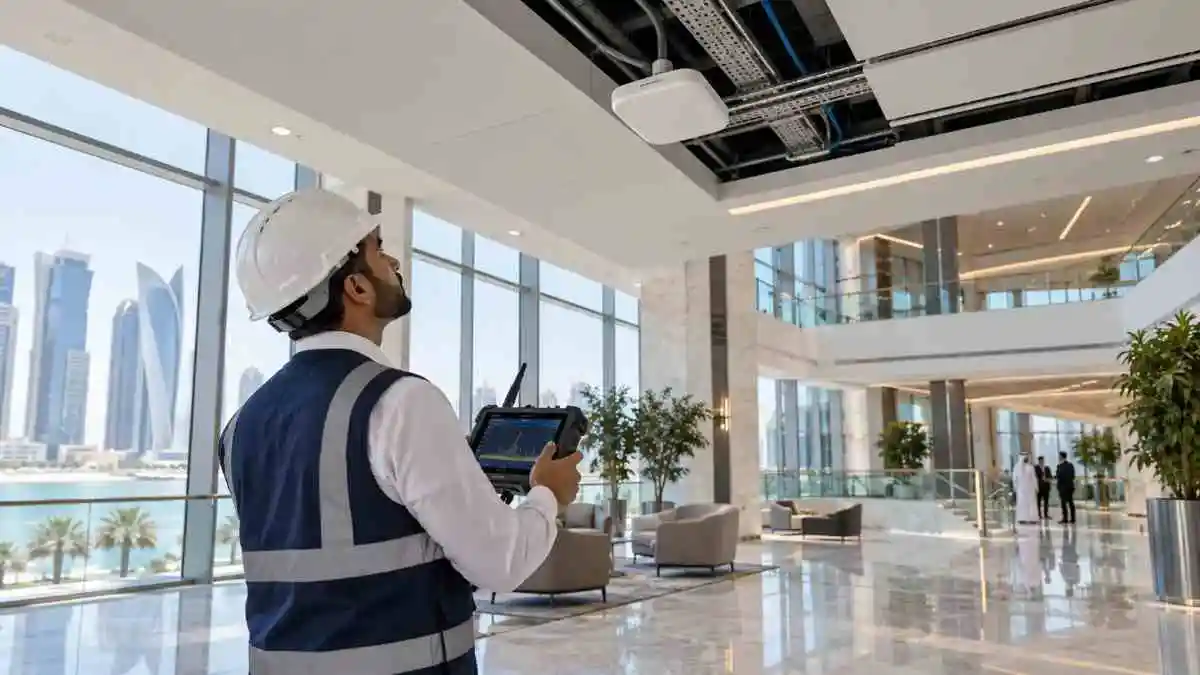
A smart building depends on more than automated lighting and connected devices. Its systems need reliable data networks, mobile coverage and carefully planned cabling to work together. For projects in Qatar, smart building telecom infrastructure should therefore be considered during design, alongside architectural and MEP plans-not after construction is complete.
The real answer is far less glamorous and far more important it’s the telecom infrastructure buried inside the walls, ceilings, and risers that most people never see.
Smart Buildings Are Built on Connectivity, Not Convenience Features
A smart thermostat or an automated lighting system is nice, but none of it functions without a robust network underneath it. Every “smart” feature access control, CCTV, building management systems, seamless indoor mobile coverage, high-speed internet across every floor depends entirely on the telecom and low voltage infrastructure installed during construction. Get that foundation wrong, and even the most expensive smart features end up feeling clunky, unreliable, or half-functional.
This is exactly where telecom infrastructure companies come in, working alongside architects and MEP consultants from the earliest design stages, not as an afterthought once the building is already up.
Fiber Is the Nervous System of a Connected Building
Optical fiber cabling, or OFC, has become the backbone of virtually every modern building project in Qatar. It carries far more data than traditional copper cabling, with lower signal loss over longer distances than many copper network links, which matters enormously in taller towers or sprawling campuses like hospitals and government complexes.
Whether it’s indoor fiber runs connecting server rooms to individual floors, or outdoor fiber linking a whole development to the wider network, this is the layer that everything else in a smart building ultimately depends on. Skimping here to save on costs almost always shows up later as slow networks, unreliable video conferencing, or systems that simply
can’t scale as the building’s needs grow. Explore our OFC solutions in Qatar for indoor and outdoor fibre networks.
Solving the Indoor Coverage Problem
Anyone who has stood in a basement parking area or a concrete-heavy office tower in Doha and lost their mobile signal has run into a problem that’s surprisingly common in modern construction. Thick concrete, energy-efficient glass, and steel structures all great for insulation and design are terrible for letting cellular signal pass through from outside
towers. The International Telecommunication Union’s guidance on indoor distribution systems also covers safety considerations for these installations.
In-building solutions such as distributed antenna systems (DAS) can improve mobile coverage in areas with weak signal. A passive DAS distributes a supplied mobile signal through antennas and cabling, while an active DAS uses powered equipment to distribute and manage coverage. A site survey helps determine which approach suits the building. An in-building distributed antenna system can help address coverage gaps identified during a site survey.
Low Voltage Systems Tie Everything Together
Beyond fiber and cellular coverage, a smart building relies on a whole layer of low voltage systems structured cabling, CCTV networks, access control, fire alarm integration, and building management systems that let facility teams monitor and control everything from a single dashboard. These systems need to be planned together, not bolted on individually by different contractors at different times, because they often share the same pathways, cabling infrastructure, and network backbone.
A building where security, HVAC controls, and IT networks were all designed as one coordinated system tends to run more efficiently and is far easier to maintain than one where each system was added separately over time. See how low voltage services in Qatar support structured cabling and connected building systems.
Why This Matters Across Every Sector
Smart building infrastructure isn’t just an office trend. Hospitals need rock-solid, redundant connectivity where downtime isn’t an option. Educational institutions need reliable networks that can handle hundreds of connected devices at once. Retail and Commercial spaces increasingly rely on connected point-of-sale systems, digital signage, and customer WiFi.
Government and finance sectors need infrastructure that’s not just fast but genuinely secure. The specifics differ, but the underlying need is the same: infrastructure that was properly planned, not improvised.
Choosing the right indoor coverage solution starts with understanding GSM active vs passive systems and which approach suits your building.
Frequently Asked Questions (FAQ)
IBS (in-building solutions) and DAS (distributed antenna systems) distribute reliable cellular signal throughout a building's interior. Larger buildings, hospitals, and structures with dense concrete or glass generally need this to avoid dead zones; smaller, simpler buildings sometimes don't.
It can be retrofitted, but it's considerably more expensive, disruptive, and limited compared to planning it in from the design stage, when cabling and equipment pathways can be built into the structure itself.
Active systems amplify and actively manage cellular signal using powered equipment, suited to larger or
more complex buildings. Passive systems rely on antennas and cabling without amplification, and work well in smaller or simpler structures.
Fiber carries significantly more data with no signal loss over distance, which is essential for taller buildings, larger campuses, and any structure expected to scale its network needs over time.
It applies broadly. Hospitals need dependable, redundant connectivity, schools need networks that handle heavy device loads, and malls rely on connected systems for security, signage, and customer WiFi the infrastructure need is universal, even if the specifics vary.
As early as possible ideally alongside your architect and MEP consultant during the design phase, so cabling pathways, equipment rooms, and system integration are planned in from the start rather than squeezed in later.
Plan Early, Save Later
The biggest mistake in any construction project is treating telecom and low voltage infrastructure as something to figure out near the end, once civil work is largely finished. Retrofitting fiber runs, in-building cellular systems, or structured cabling into a completed building is dramatically more expensive and disruptive than planning it in from the start alongside the civil and MEP works.
Planning fibre routes, equipment rooms, indoor mobile coverage and low voltage systems early makes it easier to support a building’s current needs and future expansion. The right design depends on the building layout, expected users and systems that need to connect.
Planning a new building or upgrading an existing facility in Qatar? Contact FAL Telecommunications to discuss your fibre, IBS/DAS and telecom infrastructure requirements.
Review FAL Telecommunications’ telecom infrastructure deployment services for project planning and implementation.
Planning solar power alongside your building’s connectivity systems? Read our guide on how to choose the best solar installation company in Qatar.
Get in touch for a quote or to discuss your project requirements.
Latest Post

FTTx Solutions in Qatar: FTTH, FTTB and FTTC Explained